

Translating Regulatory Clauses into Executable Codes for Building Design Checking via Large Language Model Driven Function Matching and Composing
Engineering Applications of Artificial Intelligence, 2025
引用方式: Zheng, Z., Han, J., Chen, K.Y., Cao, X.Y., Lu, X.Z., Lin, J.R.* (2026). Translating Regulatory Clauses into Executable Codes for Building Design Checking via Large Language Model Driven Function Matching and Composing. Engineering Applications of Artificial Intelligence, 163, 112823. doi: 10.1016/j.engappai.2025.112823 http://doi.org/10.1016/j.engappai.2025.112823
摘要
将规范条文转换为可执行代码是自动化规则检查(ARC)的关键环节,对智能审图或建筑工程合规性检查至关重要。当条文包括隐含属性或需领域知识时,从中解读复杂计算逻辑和规则显得更加重要。为此,本研究首先通过系统分析建筑工程设计有关规范条文,引入并定义了66个基元函数以封装共用的计算逻辑和推理规则;其次,提出基于大型语言模型(LLM)的方法 LLM-FuncMapper,该方法引入了规则驱动的自适应提示学习,可自动匹配和组合与规范条文相关的基元函数,从而快速生成可执行代码。实验表明,LLM-FuncMapper在函数匹配任务上较微调方法性能提升 19%,同时大幅减少人工标注工作量;案例研究证实,该方法可自动组合多个原子函数生成可执行代码,提升规则检查效率。据笔者所知,本研究首次将LLM应用于复杂设计条文到可执行代码的自动转换,为LLM 在建筑领域的进一步应用提供了有益参考。
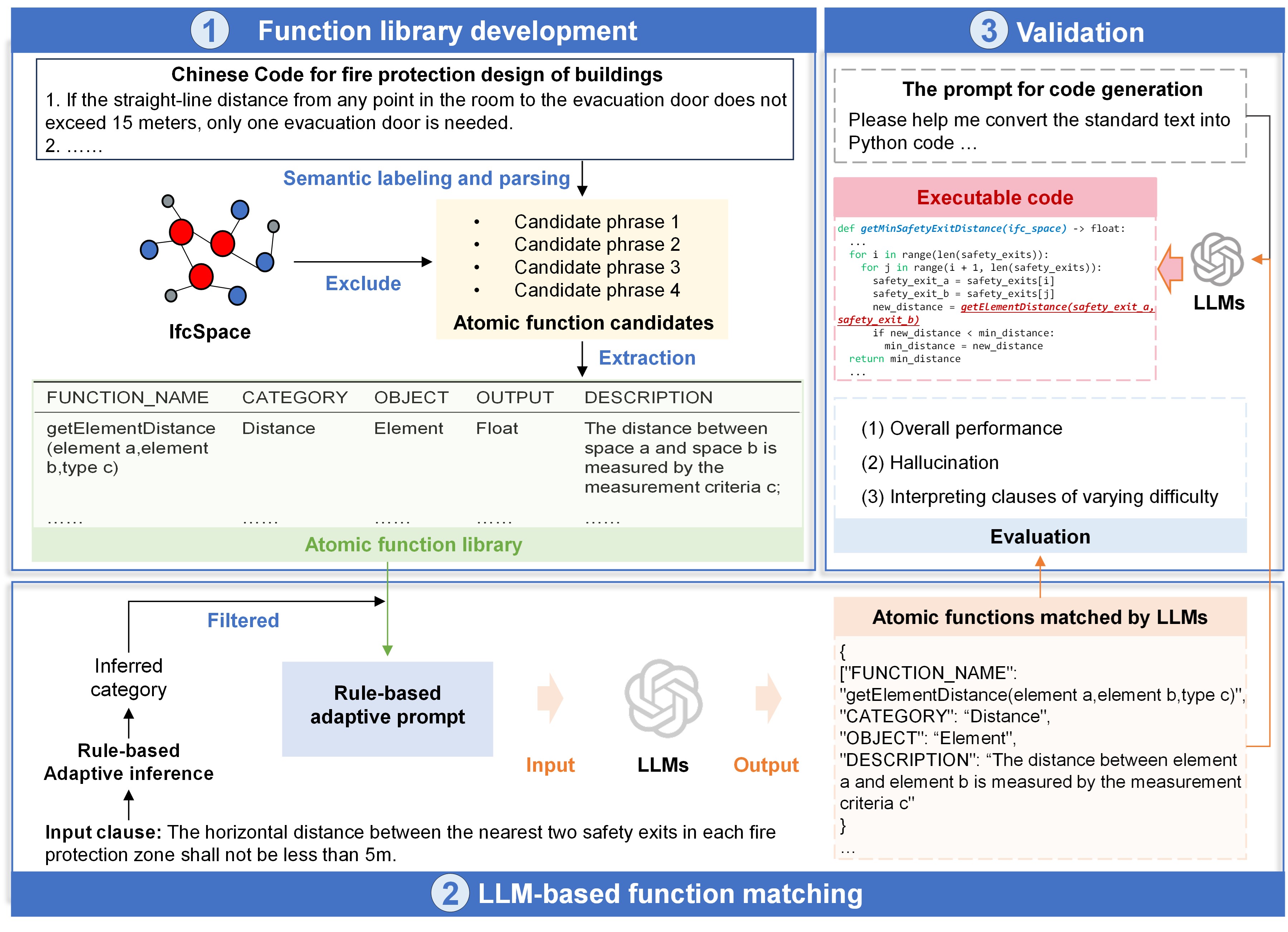
Translating clauses into executable code is a vital stage of automated rule checking (ARC) and is essential for effective building design compliance checking, particularly for rules with implicit properties or complex logic requiring domain knowledge. Thus, by systematically analyzing building clauses, 66 atomic functions are defined first to encapsulate common computational logics. Then, LLM-FuncMapper is proposed, a large language model (LLM)-based approach with rule-based adaptive prompts that match clauses to atomic functions. Finally, executable code is generated by composing functions through the LLMs. Experiments show LLM-FuncMapper outperforms fine-tuning methods by 19% in function matching while significantly reducing manual annotation efforts. Case study demonstrates that LLM-FuncMapper can automatically compose multiple atomic functions to generate executable code, boosting rule-checking efficiency. To our knowledge, this research represents the first application of LLMs for interpreting complex design clauses into executable code, which may shed light on further adoption of LLMs in the construction domain.
The authors are grateful for the financial support received from the Beijing Municipal Science and Technology Plan Project (Z231100005923043), and National Natural Science Foundation of China (No. 52238011, No.52378306, No. 51908323).
发表评论